
Higgs Centre School of Theoretical Physics 2026
Event description
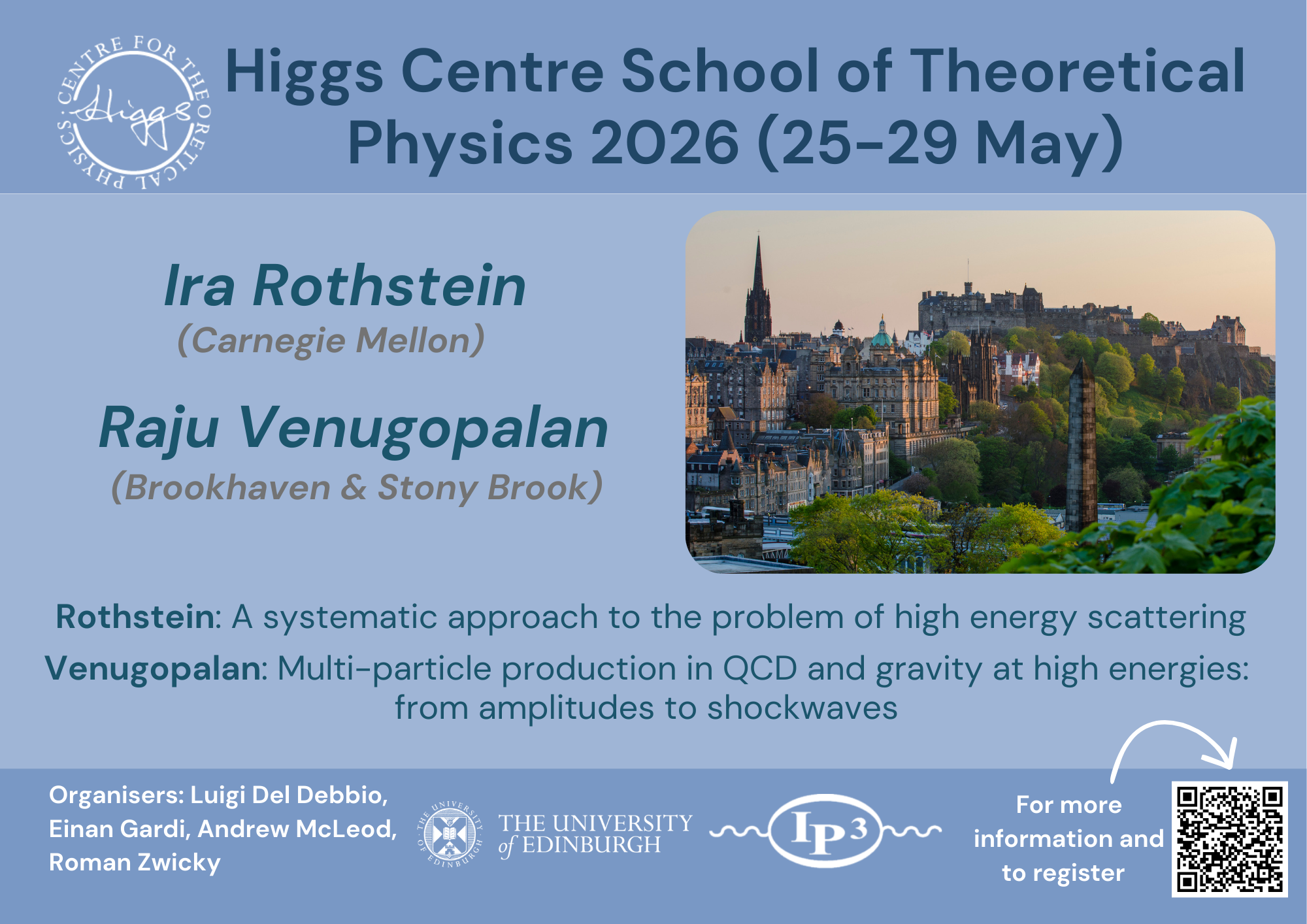
The 11th edition of the Higgs Centre School of Theoretical Physics will take place from the 25th-29th of May 2026. The scientific programme starts at 9:00 on Monday the 25th, and ends at 17:00 on Friday the 29th.
The School comprises two in-depth lecture series, each involving five 2-hours lectures delivered on the blackboard, and a similar number of tutorials.
For this year's School our two lecturers will be Ira Rothstein (Carnegie Mellon University) and Raju Venugopalan (Brookhaven National Lab and Stony Brook University) who are both on Sabbatical in Edinburgh.
Ira Rothstein - A Systematic Approach to the Problem of High Energy Scattering
In these lectures I will use Effective Field Theory techniques to develop a formalism which allows one to systematically calculate scattering amplitudes for gauge theories in the so-called Regge limit where s>>t. Quantum field theory in this limit is particularly challenging as the usual perturbative expansions enhanced by canonical renormalization group techniques fail. I will demonstrate how effective field theory techniques can be used to systematically calculate in an expansion in t/s while re-summing logs of the large ratio s/t. The importance of the Regge limit for collider experiments as well as gravitational astronomy will be discussed.
Outline of Lectures:
1) Introduction to canonical effective field theories
2) Modal Effective Field Theories: SCET for QCD Hard Scattering
3) Modal Effective Field Theories: SCET for QCD in Regge limit
4) The rapidity renormalization group
5) Forward Scattering in GR: The classical and the quantum.
Raju Venugopalan - Multi-particle production in QCD and gravity at high energies: from amplitudes to shockwaves
These lectures discuss multi-particle production in QCD and in gravity at ultra-relativistic energies, the remarkable double copy relations between the two, and strong parallels in emergent shockwave dynamics. We begin by motivating why these issues are strongly relevant for current and future experimental programs, both at colliders and at gravitation wave observatories. They also touch upon outstanding open problems in theories that are sometimes believed to be well-understood.
We next demonstrate how dispersive techniques from S-matrix theory can be applied to derive the BFKL equation for multi-gluon production in Regge asymptotics. Identical methods apply in gravity and are captured by a gravitational Lipatov equation. The building blocks in both cases are so-called Lipatov vertices and reggeized propagators. These satisfy double copy relations, and their dynamics is captured by a reggeon field theory. In gravity, Weinberg's soft theorem is recovered as a limit of the Lipatov framework; soft theorems can similarly be derived in the gauge theory context.
BFKL evolution in QCD generates non-perturbative wee parton states of maximal occupancy characterized by an emergent semi-hard saturation scale. Renormalization group equations in a Color Glass Condensate (CGC) EFT describe wee parton correlations and their rapidity evolution. We outline the concrete connections between the CGC EFT and reggeon field theory. A shockwave picture of deeply inelastic scattering and hadron-hadron collisions follows, with multi-particle production described by Cutkosky's rules in strong time-dependent fields. We outline the generalized factorization theorems that capture universal features of this dynamics, the end result of which is the formation of a quark-gluon plasma.
Gluon radiation in the CGC EFT has a double copy in gravitational shockwave collisions, with a similar correspondence applicable between gluon and graviton shockwave propagators. Possible extensions of this semi-classical double copy are outlined for computing multi-particle production in gravitational shockwave collisions, self-force and tidal contributions, and classical and quantum noise in the focusing of geodesics, opening a novel EFT motivated window into black hole formation and gravitational radiation.
Information for delegates: This is an in-person event only and the fee to attend is £50 (for external participants only). A funding subsidy towards the cost of accommodation (£200) will be available to the first 25 external applicants who register and attend the event.
If you have any questions please contact sopa.events@ed.ac.uk
REGISTRATION IS NOW OPEN
All participants in HCTP activities are expected to show respect and courtesy to others throughout the duration of an event, including at social events. We draw the participants’ attention to the HCTP Code of Conduct
Travel Scam!
If you received emails from travellerpoint(dot)org (or another travel company), please be careful. The email asks about arrival and departure dates to Edinburgh and offers a hotel booking form where they ask for credit card details. Please, ignore the emails and do not reply nor click on any link given by them. You can also block the domain on your email client. Our official emails are all from this website’s domain “@ed.ac.uk” (usually, sopa.events@ed.ac.uk). Please avoid giving private information to external sources. The only official way to register for our workshops and events are advertised via this website (or indico) and we will get in touch directly if we book accommodation for you.
Sponsorship
This school is funded by the Higgs Centre with support from the IPPP, Durham.
Higgs Centre School of Theoretical Physics 2026
Venues
Edinburgh
EH9 3FD
UK
Related events
This event is part of:
Organisers
- Luigi Del Debbio(
- University of Edinburgh
- Einan Gardi(
- University of Edinburgh
- Andrew McLeod(
- University of Edinburgh
- Roman Zwicky(
- University of Edinburgh
Key speakers
- Ira ROTHSTEIN (Carnegie Mellon University)
- Raju VENUGOPALAN (Brookhaven)
Registration closes on Thursday 30 April 2026.
Resources
- Workshop Poster image
- Privacy Notice MS Word
Find us on social media:
TwitterFacebookYouTube