Active Matters: Progress and Challenges Across Disciplines
Event description
Active Matters: Progress and Challenges Across Disciplines
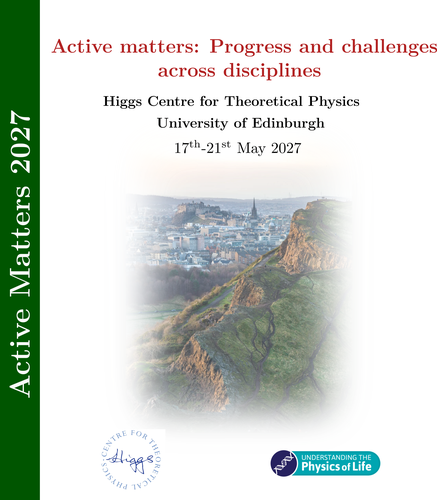
Active matter describes physical, biological, chemical, and synthetic systems whose constituents convert energy from their surroundings into directed motion. Typically, these constituents interact with each other, resulting in non-equilibrium collective behaviour; as is seen in natural systems, including animal flocks, swarming bacteria, cell locomotion, and even in minuscule molecular motors. Similar phenomena are also present in synthetic matter including Janus colloids, robots ,and programmable meta-materials. In general, the relevant behaviour observed in active matter is very difficult, if not impossible, to reproduce using passive (equilibrium) constituents. Thus, with their wide-ranging functionality, there is a huge potential to base the next generation of materials, devices, and therapeutics on active matter. However, significant challenges, from fundamental theory all the way to biology and engineering, thwart this endeavor. To resolve these interdisciplinary challenges, over the past two decades scientists have entered the field of active matter from biology, biochemistry, biophysics, statistical physics, thermodynamics, mathematics, scientific computing, and, increasingly, machine learning and artificial intelligence.
While many conferences and workshops focus on active matter from the perspective of a single discipline, this workshop aims to create a forum that unites researchers from diverse backgrounds. The scientific programme will cover five interconnected themes:
(a) statistical physics and collective behaviour;
(b) biological and proliferating active matter;
(c) synthetic and programmable active matter;
(d) control, optimization and intelligent active matter;
(e) mathematical and numerical techniques.
Together, these themes encompass fundamental questions of collective dynamics, non-equilibrium thermodynamics, biological organisation, programmable materials, intelligent control, and the theoretical and computational tools required to understand them. Each theme will occupy one conference day and will include two keynote talks by leading international experts that spotlight recent advances and outstanding challenges. In addition, each theme will include contributed talks, ensuring substantial opportunities for early-career researchers to present their work and engage with the wider community. Dedicated poster sessions associated with each focus area will further promote scientific exchange, discussion, and networking across disciplines. We further envisage engaging with the public through an evening (lay) lecture by a renowned scientist.
We expect that the workshop will foster interdisciplinary exchanges between theorists and experimentalists, strengthen connections across traditionally separate research communities, and provide opportunities for early-career researchers to present their work and engage with leaders in the field. By bringing together expertise from multiple disciplines, the workshop aims to identify emerging research directions, highlight common challenges and methodologies, and establish new collaborations that will advance the understanding and application of active matter systems.
Confirmed speakers:
TBC
All participants in HCTP activities are expected to show respect and courtesy to others throughout the duration of an event, including at social events. We draw the participants’ attention to the HCTP Code of Conduct
Travel Scam! If you received emails from travellerpoint(dot)org (or another travel company), please be careful. The email asks about arrival and departure dates to Edinburgh and offers a hotel booking form where they ask for credit card details.
Please, ignore the emails and do not reply nor click on any link given by them. You can also block the domain on your email client.
Our official emails are all from this website’s domain “@ed.ac.uk” (usually, sopa.events@ed.ac.uk). Please avoid giving private information to external sources. The only official way to register for our workshops and events are advertised via this website (or indico)

Active Matters: Progress and Challenges Across Disciplines
Venues
Edinburgh
EH9 3FD
UK
Organisers
-
Thibault Bertrand
(
- Imperial College London
-
Lennart Dabelow
(
- Queen Mary University of London
- Luke Davis(
- University of Edinburgh
- Alexander Morozov(
- University of Edinburgh
-
Gunnar Pruessner
(
- Imperial College London
Resources
- Physics of Life Logo image

Find us on social media:
TwitterFacebookYouTube